

Picture this:
It’s the end of the month.
A sales team has been making hundreds of calls month.
Client meetings filled the calendar.
Proposals were sent.
Follow-ups happened.
The CRM updated every night and filled with activity!
On paper it looks like a productive month.
Then the revenue report comes in.
And suddenly the heavy question:
”With everything we did… why didn’t we close more deals?”
If you’re a founder, a sales manager, a sales rep, or an entrepreneur, you’ve probably lived this exact frustration.
Prospects who go quiet, decision-makers who suddenly disappear, and the line that stings more than any rejection ever could: “we’ll get back to you” or “we’re not ready yet.”
In that moment the prospect isn’t ghosting because a competitor swooped in. They’re ghosting because doing nothing feels safer than saying yes. If they buy a solution and it doesn’t work out, that’s on them.
If they just… don’t decide, nobody blames them for that. The problem was already there before anyone showed up, so leaving it unsolved costs them nothing they can see.
Your Biggest Competitor Isn’t Another Company. It’s Your Client’s Decision.
Now that’s something many sales professionals don’t realise.
Most deals don’t fall apart because a competitor came in with a better offer.
They fall apart because the buyer decides to do… nothing.
The problem already existed before they met you, so delaying the decision rarely feels like an immediate loss. From the buyers perspective, waiting often seems less risky than acting.
And that single psychological barrier quietly kills deals, more than price, competition, or product features ever will.
Today’s buying journey has become even more complicated.
Reports have shown that before most clients schedule a meeting or respond to your proposal, they’re already researching you. They’re reading reviews, checking LinkedIn, comparing competitors online and increasingly, asking AI tools like ChatGPT or other assistants questions such as:
– Which firm has the strongest reputation in this field?
– Who would you recommend for this project?
Those answers may not make the final decision for them, but they often shape their first – most times even second – impression about your brand / product / service.
That’s why today’s competition isn’t just another company.
You’re also competing with every other piece of information that influences your buyer’s decision before they ever speak to you.
According to research from Ebsta and Pavilion’s 2025 Sales Benchmark Report, average B2B win rates declined from 29% in 2024 to 19% in 2025.
It wasn’t because sales professionals suddenly became less capable. Buyers simply became more cautious, involved more stakeholders in purchasing decisions and took longer to commit.
The reality is that every lost deal usually falls into one of three buckets:
- The buyer went with someone else.
- The buyer postpones the decision indefinitely.
- The buyer found a way to solve it internally, without making a purchase.
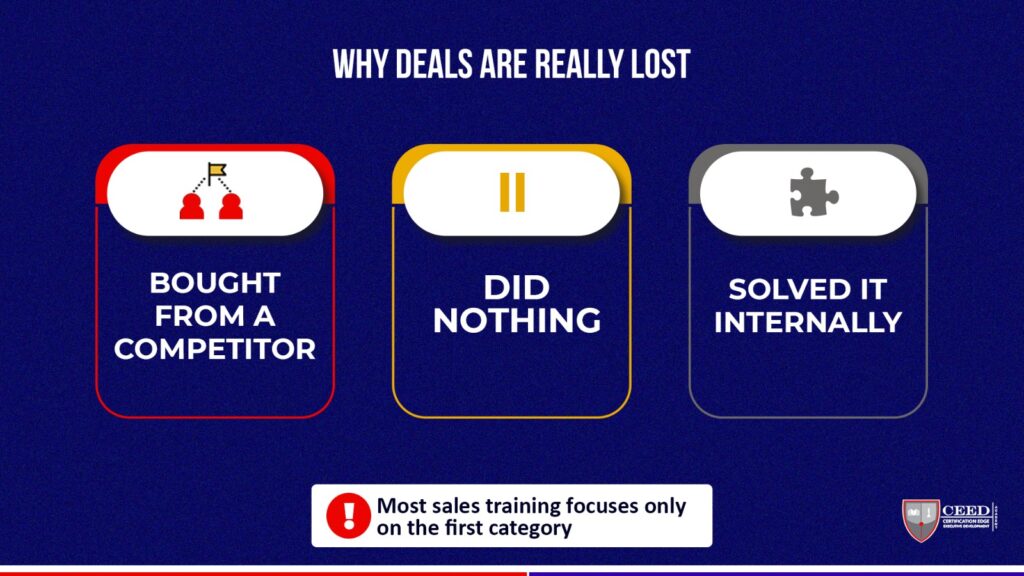
Ironically, most sales training focus almost almost entirely on the first bucket – how to outperform a competitor.
Very little attention is given to help buyers overcome uncertainty or navigating internal decision-making, even though that’s where many deals are quietly lost today.
Research from RAIN Group found that successful sales professionals build relationships with an average of five stakeholders involved in the buying decision, while unsuccessful deals typically involve only two meaningful contacts.
Meanwhile, HubSpot reports that 80% of successful sales require at least five follow-ups, yet nearly half of sales professionals stop after the very first attempt.
On top of that, Salesforce’s State of Sales Report shows that today’s buying process involves more decision-makers than ever before, making consensus significantly harder to achieve.
None of these challenges point to a talent problem.
They point to a skills problem.
The highest-performing sales professionals learn how to guide buyers through uncertainty, build trust across multiple stakeholders, reduce perceived risk, and create enough confidence for people to move from “we’ll think about it” to “let’s move forward.”
Because that’s what selling has always been.
In this article we’ll be disclosing five (5) strategies that consistently separate high-performing sales professionals from everyone else. But first lets understand…
What is sales, really?
Lemme guess; you think it’s persuasion, or the ability to convince or even pressure your client to buy from you.
Or probably a script delivered smoothly enough to wear someone down.
As Coursera’s breakdown of sales training puts it, the professionals who actually succeed combine communication, negotiation, relationship-building, and active listening, not persuasive speaking alone.
Hence, sales is about helping people make confident decisions.
It’s diagnosing the real problem, understanding what’s preventing action, and making the decision to move forward feel safer than the decision to stay exactly where they are.
That’s the difference between sales professionals who stay busy…
…and those who consistently close the biggest deals.
Now lets fully breakdown what sales professional do differently.
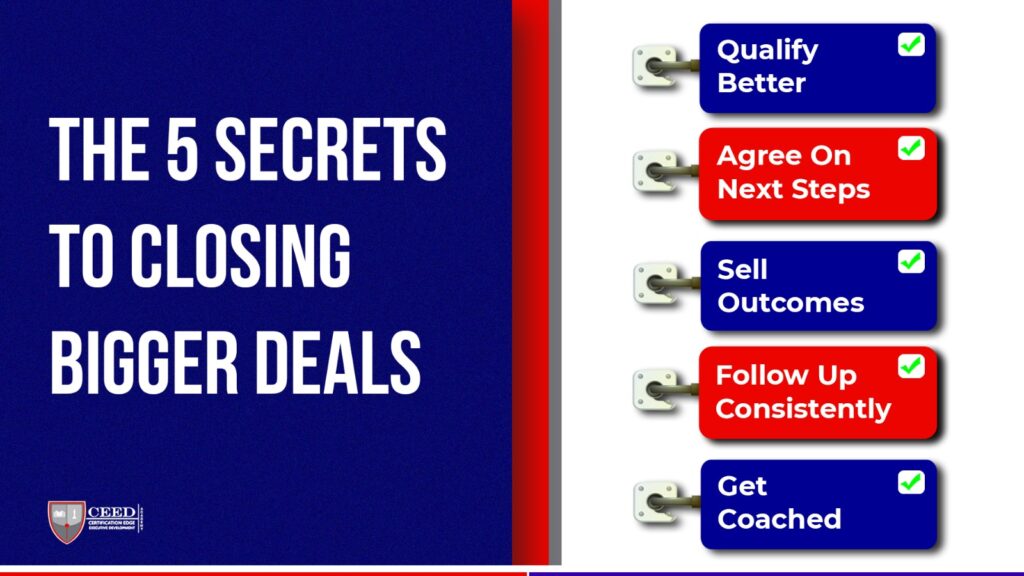
5 Secrets High-Performing Sales Professionals Use To Close Bigger Deals
As we’ve established, closing big deals isn’t about becoming more persuasive or about memorizing better objection-handling scripts.
And it certainly isn’t about talking your way into a client’s budget.
This may be new to you, but the best sales professionals in the world don’t win because they’re better talkers.
It’s simply because they’ve learned to remove uncertainty long before anyone is asked to sign a contract.
Research from organisations like Gartner, Gong, HubSpot, RAIN Group, Salesforce and Pavilion continues to point in the same direction:
The highest-performing sales professionals spend less time trying to “convince” buyers…
…and far more time shaping how buyers think, evaluate risk and build confidence throughout the buying journey.
Here are five principles they consistently apply.
1.They Win Before The First Conversation Ever Happens
One of the biggest shifts happening in sales today has less to do with sales conversations.
It happens before they even begin.
Today’s buyers rarely enter meetings without doing their homework first.
They’ve visited your website.
Read your LinkedIn profile.
Watched your videos.
Checked testimonials.
Compared competitors.
And now, they’re asking AI tools like ChatGPT, Gemini, and Perplexity questions about your company before scheduling that call with you.
This has nothing to do with posting repeatedly or jumping on the fastest-growing trend.
If your digital presence doesn’t communicate expertise, credibility and trust, you’ve already lost momentum before introducing yourself.
You can’t rely solely on cold outreach, you have to intentionally build authority long before prospects ever become prospects.
Because people buy faster from brands they already trust.
2. They Don’t Sell Products. They Help Buyers Make Decisions.
Most sales professionals believe they’re selling a product.
The best ones know better… they know they’re selling confidence.
Every buyer is asking one question they rarely say aloud:
“What happens if I make the wrong decision?”
Now, that’s the real objection.
Not price, timing, or budget.
But risk.
The role of a sales professional isn’t to pressure someone into buying.
Its to reduce enough uncertainty that saying “yes” feels safer than saying “not yet”.
So the gaol is to focus more on helping your client confidently justify their decision, and less on explaining your products.
3. They Build Consensus, Not Just Relationships
Many sales professionals celebrate after finding one enthusiastic champion inside an organization.
That’s rarely enough.
Modern buying decisions involve procurement.
Finance.
Operations.
Technical teams
senior Executives
Sometimes legal.
Research from RAIN Group shows winning deals involve significantly more stakeholder relationships than losing ones.
Closing large deals isn’t about convincing one person.
It’s about helping multiple people arrive at the same conclusion.
So don’t just ask,
“Who makes the decision?”
Start asking,
“Who influences it?”
4. Follow up like it’s the job, not a favour
Most sales that close take 5 or more follow-ups to get there. Nearly half of all reps never even attempt a second one. The deal doesn’t usually go cold because the buyer lost interest — it goes cold because the rep disappeared.
Following up isn’t asking “have you decided yet” on repeat. It’s staying present, answering the next question, and keeping the thread alive until there’s an actual answer, yes or no.
Sometimes, when a buyer says,
”we’ll get back to you.”
They genuinely intend to.
Sometimes they don’t.
But the difference between average and exceptional sales professionals is that exceptional ones never leave momentum to chance.
Because deals rarely die from dramatic rejections.
They slowly disappear inside unanswered emails, postponed meetings and forgotten priorities.
5. They Invest More In Their Sales System Than Their Sales Script
Now this one most reps skip.
The highest-performing sales teams don’t obsess over closing techniques.
They obsess over process.
How opportunities are qualified.
How conversations are structured.
How follow-ups are managed.
How digital authority is built.
How proposals are positioned.
How objections are anticipated.
How value is demonstrated.
How customer success stories are shared.
That’s why elite organizations train their sales reps to build repeatable systems that consistently produces sales success.
The Difference Between Busy Sales Teams And High-Revenue Sales Teams
Most organisations don’t have an effort problem.
You’ll find their teams constantly making calls.
Attending meetings.
Sending proposals.
Updating CRMs.
Working incredibly hard.
But they lack a sales execution problem.
They’re relying on activity to produce results when today’s market demands something very different.
That’s exactly why we created the Ultimate Sales Bootcamp at CEED Academy.
Not to teach outdated sales scripts.
Not to motivate people for two days before they return to old habits.
But to help founders, sales professionals, business development executives and commercial leaders build the practical systems that consistently convert conversations into contracts.
Ready to Build a Sales Team That Consistently Wins?
If your team is busy but revenue isn’t growing at the same pace…
If your proposals keep ending in “We’ll think about it…”
Or if you’re tired of losing opportunities that should have been yours…
Perhaps the problem isn’t your product.
Perhaps it’s the sales system behind it.
The Ultimate Sales Bootcamp was designed to close that gap.
Through practical simulations, real-world sales scenarios, buyer psychology, stakeholder management, digital positioning, negotiation and execution frameworks, participants learn how today’s highest-performing sales professionals consistently win complex, high-value deals.
Because in today’s market, the companies that grow fastest won’t be the ones making the most sales calls. They’ll be the ones building the most trusted sales teams.

Ready to transform how your team sells?
Explore CEED Academy’s Ultimate Sales Bootcamp and discover how your sales professionals can start closing bigger, better and more profitable deals.
Contact us today to learn more about upcoming cohorts and corporate training opportunities.
Final Thoughts
The biggest deals are rarely won in the final meeting.
They’re won in every interaction that comes before it.
In the trust you’ve built before the first conversation. In the questions you ask during discovery. In the confidence you create throughout the buying journey. In the value you demonstrate long before discussing price..
Because in today’s market, products can be copied. Prices can be matched. Competitors will always exist.
But trust, credibility, and a repeatable sales system are far harder to replicate.
Strive to become the organization whose sales team know how to build relationships, navigate complex buying decisions, communicate value, and turn opportunities into long-term business growth.
But these are skills that don’t happen by chance.
They’re developed intentionally.
If your goal is to build a sales team that doesn’t just stay busy but consistently wins bigger opportunities, closes with confidence, and drives measurable revenue growth, the Ultimate Sales Bootcamp was designed for exactly that.
At the end of the day, sales isn’t about convincing people to buy. It’s about becoming the obvious choice when they’re ready to decide.
More from CEED Academy:
Sales Leadership Acceleration Programme (SLAP)
Global Senior Leadership Acceleration Program (G- SLAP)

Very profound