
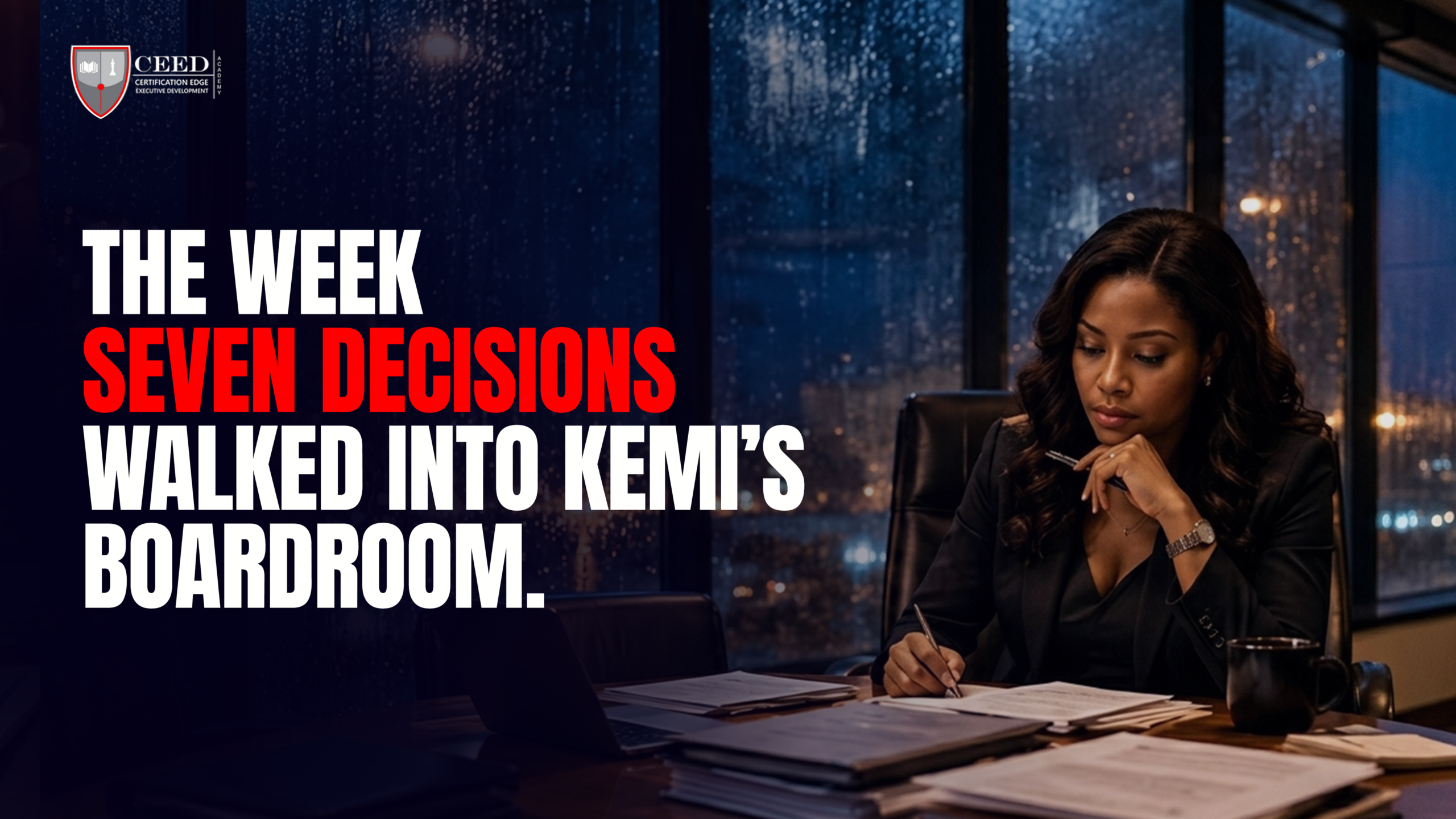
Sunday evening in Ikeja, and the rain had turned the boardroom windows into something close to frosted glass. Kemi sat alone at the head of the long table with the pile of paper she had been avoiding all week: a resignation letter from her head of operations, a distributor’s proposal for a new market, a bank’s term sheet still unsigned, an organisation chart with three names crossed out and two question marks, and a strategy deck that had been through three management meetings without changing a single thing in the business.
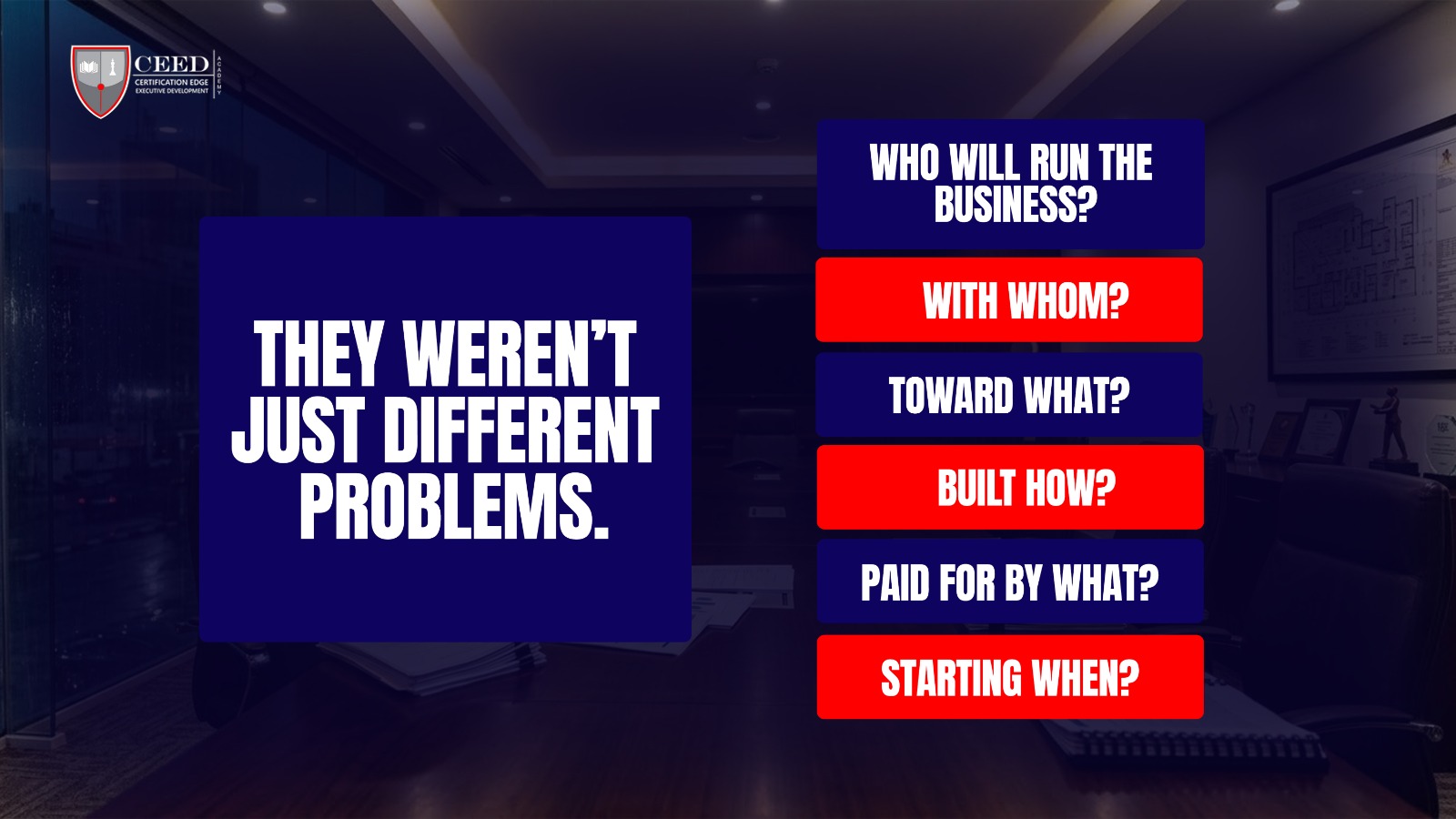
Each had arrived on a different day, wearing a different face, and she had handled each the way she handled most things in the business: quickly, alone, and between other things. But laid out together under the boardroom lights, they no longer looked like separate problems. They looked like one conversation she had been postponing. Who would run the business, with whom, toward what, built how, paid for by what, and starting when?
She had founded the company nine years earlier and had, without quite noticing, been making its most important decisions in car parks, in traffic on the Third Mainland Bridge, and in the last five minutes of other meetings. Most founders do. Very few ever walk into the decision room on purpose.

People and structure: the resignation letter
She started with the resignation, because it stung most. Her head of operations had not been difficult. He had been the only person in the company who ever walked into her office with a problem and a solution in the same hand. Everyone else brought her questions, and she, proud of her speed, had answered them all. It dawned on her slowly that she had spent nine years training her team to wait.
Ajibola Bamidele measures people in an organisation on a ladder: the one who sees a problem, the one who also sees the solution, the one who raises it, the one who carries it through, and finally the one who builds a system so it never returns. Kemi measured her managers against that ladder and found most of them stuck on the first rung, through no fault of their own. Nobody had ever asked them to climb. Growth demands more decision-makers, not more dependents, and that meant stronger middle leaders, clearer roles, and a hard look at whether the key seats in her company, the ones whose failure could bring the building down, were filled with the right people.
Strategy and timing: the deck and the distributor
The strategy deck troubled her for a different reason. Every sentence in it was true, and none of it told anyone what to do on Monday. Vision without strategy, Ajibola Bamidele tells leaders, is a hallucination. And a goal without an objective is a wish with a date on it: goals are easy to set, but an objective makes you a little uncomfortable, because it is specific enough to fail. She began rewriting the deck, this time looking inward at her culture and outward at the competitor who had just launched in her best market.
The distributor’s proposal carried the question of timing, and with it the thing she feared most: having to decide without knowing enough. She had always waited for the full picture. But the higher a leader climbs, the less the picture completes itself. Junior roles come with clear tasks and clear answers, he says. Senior roles come with unclear problems and no obvious answers, and the leaders who thrive are the ones who can decide with incomplete information, stay calm enough that their panic does not become the team’s, and then act, test and adjust. You do not shut the factory to repair the machine. You repair it while it runs.
Culture, capital and partnerships: the term sheet
The term sheet made her think about capital, and then, unexpectedly, about technology and culture. Dr. Benson Uwheru has said that technology should be treated as a business need, not as hype, and that scalability is not about volume but about velocity and consistency of quality. A loan taken to buy systems for a company whose people wait for permission only scales the waiting.
Culture, as Ayodeji Ajibola puts it, doesn’t happen; leaders build it. It is the unwritten set of values that shapes how people behave when she is not in the room, built by what a leader rewards, punishes and tolerates. Who got promoted in her company, and why? What happened when someone made an honest mistake? She did not love her own answers.
She loved the next question even less. Oluchi Bamidele, known as Coach Lulu, tells leaders they cannot keep driving their teams without asking who is looking out for them. Kemi had not taken a full weekend off in two years, and she could see now how many of her worst decisions had been signed at the end of a long day, tired and in a hurry. Rest, she began to think, was not a reward for leadership. It was part of the job.
The partnership was the easiest to see clearly. The companies she admired had grown by choosing partners and role models that raised their standards, not ones that reflected their habits back at them. She would say yes, but only once she could say what she wanted her company to become.
 The leader in the room
Near midnight she understood that the seven decisions were really one: who she needed to become in order to make them. Steve Jobs, pushed out of Apple in 1985 and back in 1997, is usually remembered for the products, yet the upgrade that mattered most was himself. Version one was impulsive. Version two was intentional.
That is the ground the Senior Leadership Acceleration Program (SLAP) covers. It is an executive-level experience for CEOs, directors, founders and senior managers, focused on strategic thinking, decision-making and team leadership, helping leaders align vision, structure and execution and build a core team that can carry the business. Acceleration here is not a shortcut. It is the deliberate work of upgrading how you lead, done in a room of peers under the same pressure you are.
Walking into the room on purpose
The Decision Room, CEED Academy’s Entrepreneurs Conclave (Lagos Edition), puts those seven decisions on the table: people, partnerships, strategy, structure, culture, capital and timing. It is led by Ajibola Bamidele, MD/CEO of Certification Edge and CEED Academy, alongside Grace Ofure of Lifecard and GO Global, Rolake Akinkugbe-Filani of EnergyInc Advisors, and Ferdy Adimefe of Magic Carpet Studios.
On Monday morning, the cleaners found the boardroom table covered in paper and, at the head of it, a single sheet with seven words in Kemi’s handwriting and a name beside each one. She had not solved anything yet. But for the first time in nine years she had walked into the decision room on purpose, as the leader the decisions required.
A business becomes whatever its leader is ready to decide.
The Decision Room takes place on 17 October 2026, 3pm to 7pm, at Radisson Blu, Victoria Island, Lagos. Attendance is strictly by invitation. To enquire, call 0817 906 4444 or 0817 069 4444,
Register your interest here


0 Comments