
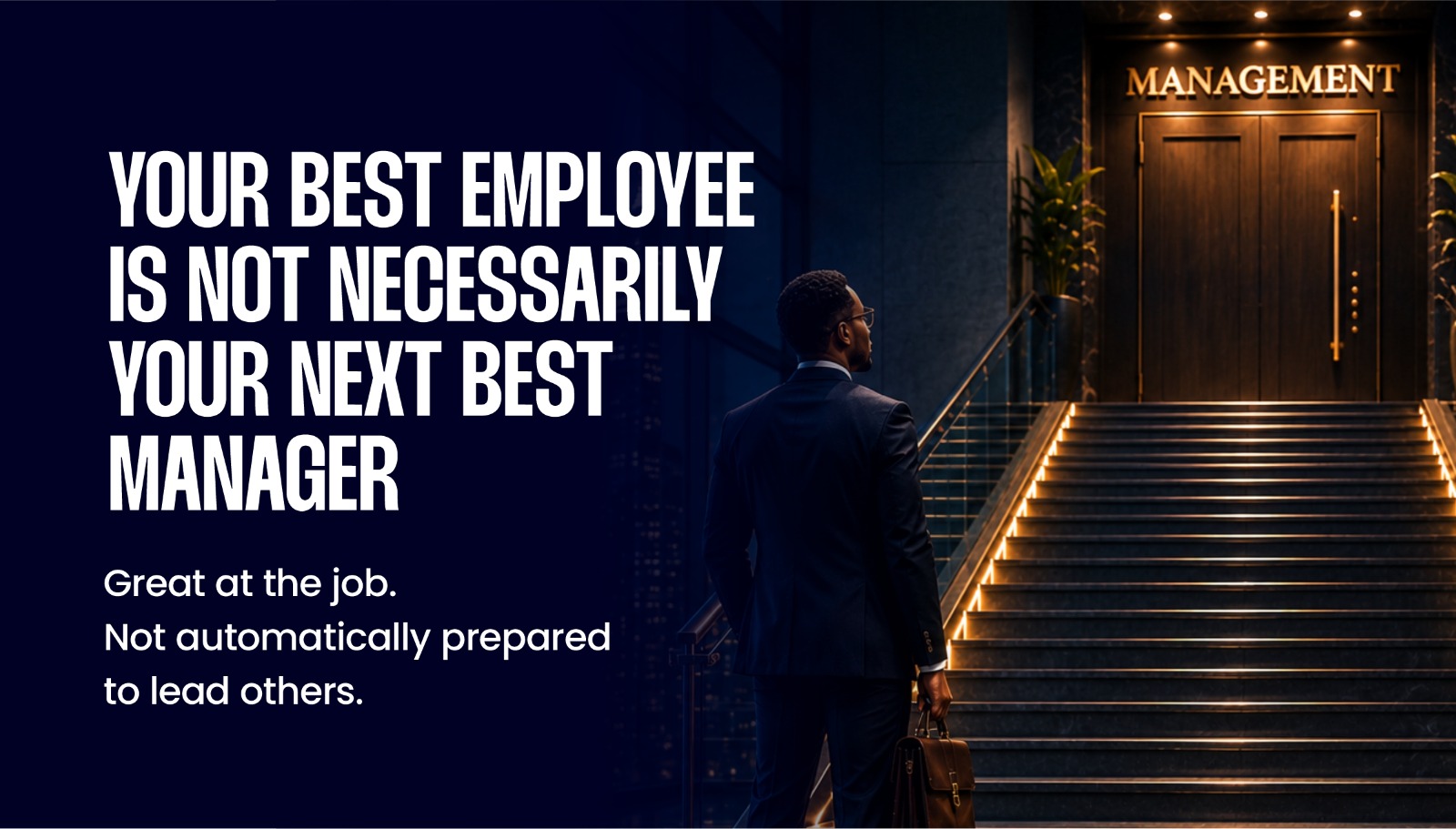
Every organisation has done it.
The top salesperson gets promoted to Sales Manager.
The strongest engineer becomes the Engineering Manager.
The most dependable operations officer suddenly becomes Head of Operations.
On paper, it feels like the obvious decision.
After all, if someone excels at their job, surely they’ll excel at leading others doing the same job.
Except that’s not how management works.
And that assumption may be one of the most expensive mistakes organizations continue to make… hopefully not yours.
But if that’s the case, it won’t be after you are done with this article.
At CEED Academy, we’ve worked with managers, business owners, founders, and executives. Across many industries: Banking, Technology, Manufacturing, Consulting, Government, Retail, and Fast-growing SMEs. The pattern is always the same.
Many organisations promote high performers into management. But they don’t prepare them for what the role actually requires. The result? Good employees struggle. Teams get frustrated. Performance stalls. And the business quietly pays for it.
The Promotion That Creates A New Problem
Imagine this:
You have a salesperson who consistently exceeds targets.
Clients love them.
They’re dependable.
They know the business inside out.
Naturally, you promote them to manage the team.
Six months later, sales performance begins to dip.
The team seems less engaged.
Decisions are delayed.
Targets are being missed.
The manager looks overwhelmed.
Everyone starts asking the same question:
“What happened?”
The answer might not be far-fetched.
The skills that made them successful as an employee are not the same skills required to succeed as a manager.
Being a great performer and being a great manager are entirely two different jobs.
One requires personal excellence.
The other requires the ability to create excellence through other people.
And that transition is far more difficult than most boardrooms realize.
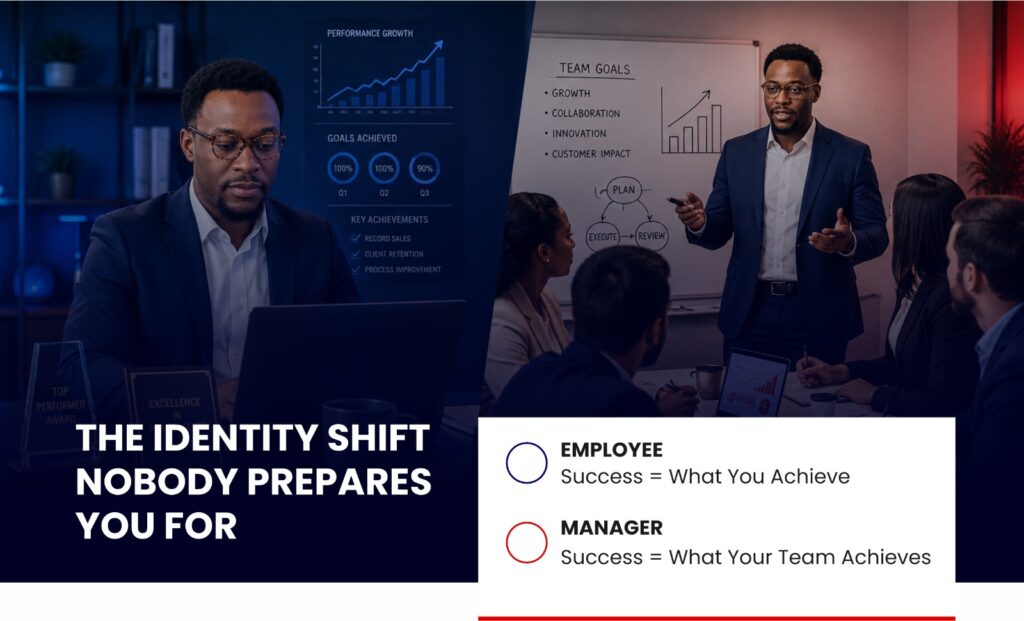
The Identity Shift Nobody Prepares You For
One of the biggest mistakes organisations make is assuming management is simply the next level of performance.
Hard truth?
It isn’t.
Management is a completely different profession.
As an employee, success comes from what you personally achieve.
As a manager, success comes from what your team achieves.
That sounds simple, right?
But trust me, it changes everything.
The way you communicate changes.
The way you solve problems changes.
The way you measure success becomes different.
Even the way you spend your time changes.
Many newly promoted managers continue operating as individual contributors.
They answer every question. Approve every task. Solve every problem. Attend every meeting. Every decision runs through them. At first, it all looks like “showing dedication to all your responsibilities”.
Eventually, it becomes a bottleneck.
You notice that the team stops thinking independently because the manager is involved in everything.
Work slows down.
Decision-making becomes centralised.
The manager becomes exhausted, and performance suffers.
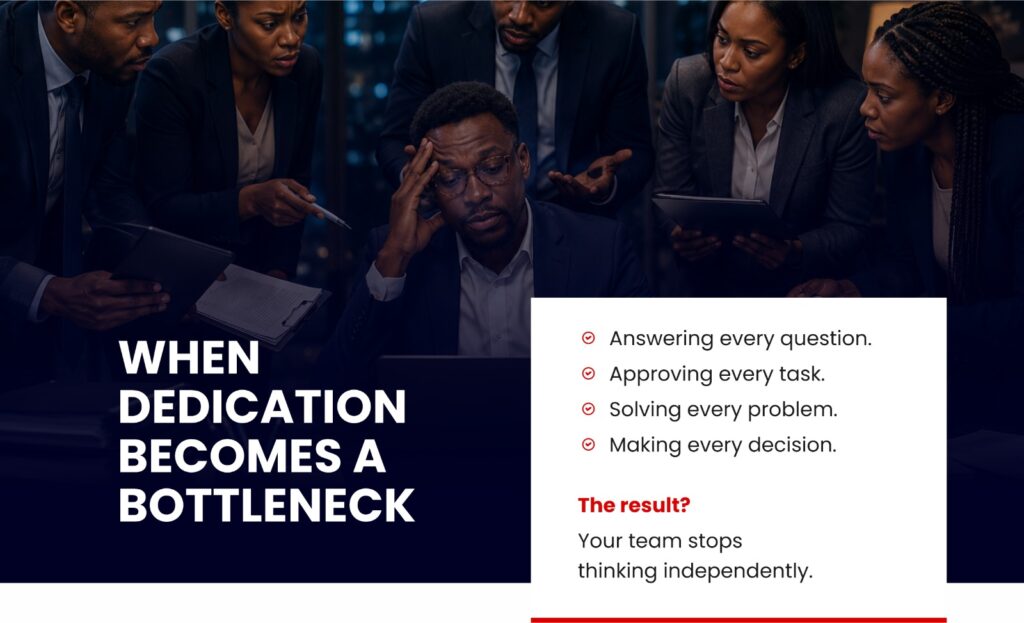
Why Smart Managers Become Leadership Bottlenecks
This isn’t because the manager lacks intelligence.
Or because they lack commitment.
But because they have not learned how to transition from doing the work to leading the work.
We’ve seen talented managers spend entire days solving problems that their teams should be handling themselves.
And no, it doesn’t have anything to do with trust.
Nobody taught them how to delegate, hold people accountable, or develop their team. So instead, they created dependency.These are learnable skills, but they need to be taught.
The Cost of an Untrained Manager
Stop underestimating how expensive poor management can be.
A struggling manager affects far more than their own performance.
They influence:
– Team productivity
– Employee engagement
– Staff retention
– Customer experience
– Project execution
– Business growth
– Leadership succession
One ineffective manager can quietly reduce the effectiveness of an entire department.
Have you heard the phrase: employees often leave managers… not organisations.
Well, that’s not just a phrase but a proven fact.
When managers lack leadership capability, turnover increases. Morale drops. Performance declines.
And organisations end up spending more time replacing talent than developing it.
The cost of untrained managers might not be visible on a balance sheet.
But it is felt everywhere.
The Accountability Problem Your Team Has
I know you believe your team has a performance problem.
But you might wanna consider that the problem is actually accountability.
Do any of these sound familiar:
Projects are delayed. Deadlines move. Commitments are forgotten. Responsibilities are unclear.
Yet nobody addresses the issue directly.
Why?
Because you’re confusing accountability with conflict.
Most managers want to maintain harmony.
They want to be liked.
They avoid difficult conversations
Unfortunately, avoiding accountability does not create healthy teams.
It only creates confusion.
Strong managers understand that accountability is not punishment… but clarity.
People perform better when ownership is defined.
When expectations are clear.
Organisations perform better when accountability becomes part of the culture.
The challenge is that very few managers are ever taught how to create accountability without damaging trust.
The Execution Gap: Where Managers Quietly Fall Behind
This may be the most expensive management gap of all.
Most businesses do not suffer from a lack of ideas, but from a lack of execution.
Leadership teams spend weeks developing plans.
Departments set ambitious targets.
Teams hold strategy sessions.
And then very little changes.
Which makes the execution break down. Priorities become unclear. Momentum disappears. Everyone stays busy, and then results remain stagnant.
This is where management becomes critical.
You might not believe this, but a manager’s role is not to supervise activity.
A manager’s role is to convert strategy into consistent execution, to close the gap between what was planned and what actually happens.
Without strong managers, even brilliant strategies fail.
Experienced Managers Are Not Left Out of the Struggle
One misconception is that only first-time managers face these challenges.
Not true.
Experience managers encounter the same issues when:
– Taking over a team
– Moving into senior leadership
– Managing larger departments
– Leading organizational transformation
– Scaling rapidly growing businesses
Every new level of responsibility demands new leadership capability.
Past experience helps.
But experience alone does not eliminate leadership gaps.
The organisations that grow sustainably understand this.
That’s why they invest in developing managers continuously, not only when problems arise.
Why Management Training Is No Longer Optional
I think we’ve been able to establish the fact that most managers are not failing because they lack potential. They are failing because they were never prepared for the role.
Organisations spend heavily on technical training, certifications, tools, and systems. Then they expect managers to figure out leadership on their own.
Now that’s an expensive expectation, because they expect the manager to learn through trial and error.
Which in turn affects productivity, accountability, team morale, customer experience, and business results.
Studies show that teams with struggling managers experience 50% higher staff turnover and productivity drops of up to 20%.
This is why management training is one of the smartest investments a growing organization can make.
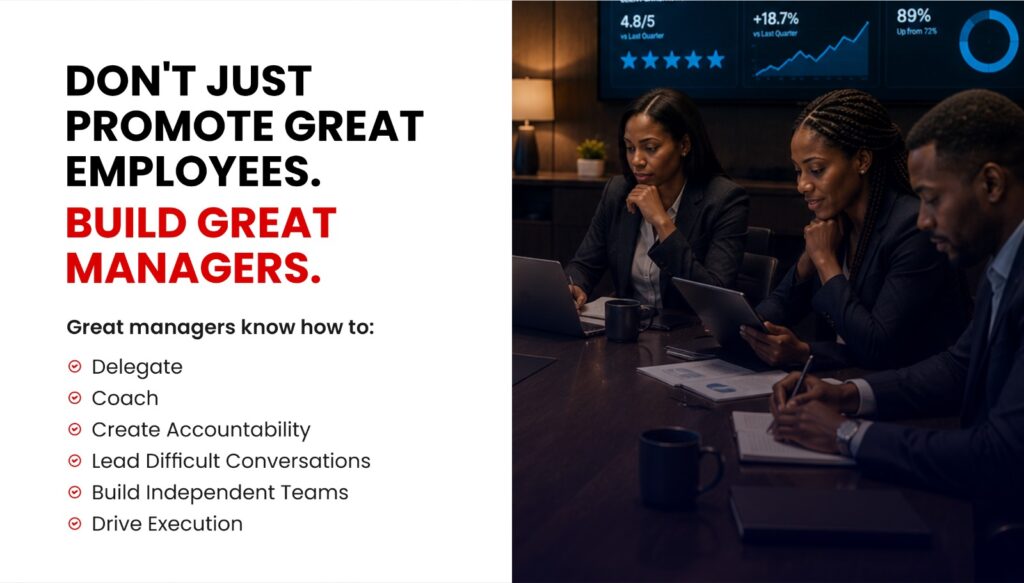
Good management training gives managers real, practical skills, including:
● How to delegate in a way that builds the team
● How to communicate with clarity and purpose
● How to create accountability that drives performance
● How to coach people and bring out their best
● How to turn strategy into consistent results
● How to manage conflict before it damages the team
● How to reduce dependency and build a stronger team over time
Most importantly, it helps managers understand how to get results through people, not just alongside them.
Building Managers Who Deliver Results
At CEED Academy, we’ve spent years helping organizations strengthen leadership. Where it matters most. At the management level.
Organizations don’t scale through strategy alone.
They scale through managers who can execute strategy through people.
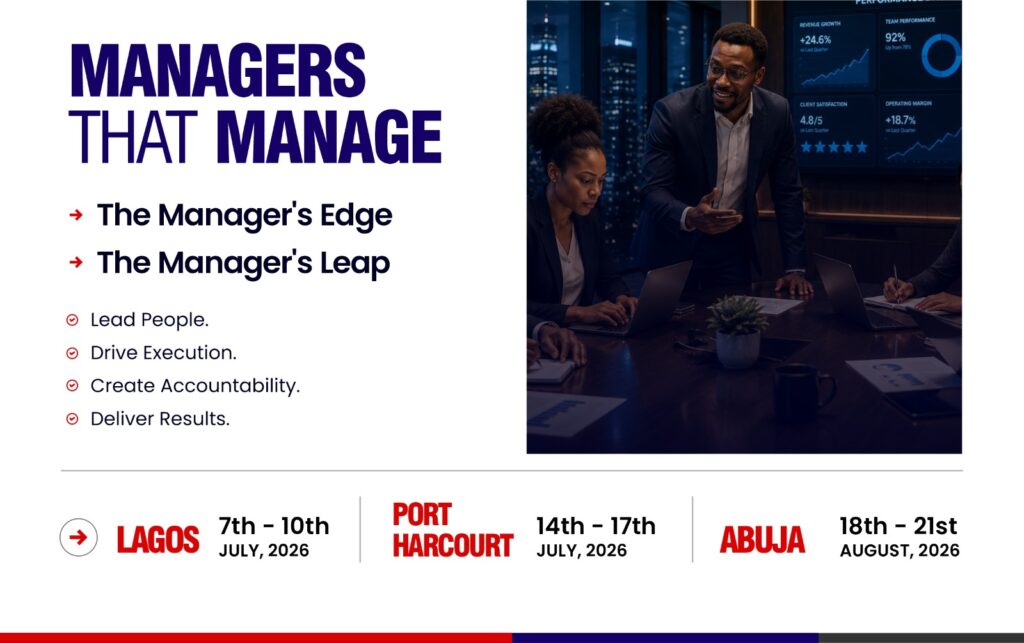
That is the thinking behind CEED Academy’s Managers That Manage program.
This is not another leadership programme built around theories and motivational quotes.
Managers That Manage is a practical development experience. It helps managers lead people. Drive execution. Create accountability. Build stronger teams. And consistently deliver results.
Managers That Manage is delivered across two development levels:
The Manager’s Edge — for newly promoted and developing managers. It builds stronger foundations in communication, delegation, accountability, team leadership, and execution.
The Manager’s Leap — for managers and team leaders ready to go further. It improves leadership effectiveness. Reduces team dependency. Strengthens decision-making. And builds the strategic thinking that scales a business.
The goal isn’t simply to help managers manage people.
The goal is to help managers create better teams, better execution, and ultimately better business outcomes.
Because that’s what management is truly about.
Promoting your best employee often feels like the obvious next step.
Sometimes it’s the right decision.
Sometimes it’s the beginning of a management problem nobody sees coming.
Being exceptional at a job is one skill. Leading others to be exceptional at it is another. One requires technical expertise. The other requires leadership.
The organisations winning today aren’t necessarily the ones with the smartest employees.
They’re the ones intentionally building stronger managers.
Managers who can create accountability without creating fear.
Managers who can delegate without losing control.
Managers who can develop people instead of creating dependency.
Managers who can translate strategy into execution, and execution into results.
Because at the end of the day, business growth doesn’t happen through plans.
It happens through people.
And people perform best when they are led by managers who know what they’re doing.
The question isn’t whether your organisation has talented employees.
The question is whether you’re giving them the management skills to lead well when the time comes.
Want to build stronger managers? Fill out this form to register for our Managers that Manage Conference.
Prefer to speak to our team? Call:
09097770025
09097770026
09097770027
Or simply explore other CEED Academy programs


One point that stood out to me is that management is a profession, not simply the next step after being a high performer. Developing skills such as delegation, accountability, coaching, and execution can make the difference between a manager who becomes a bottleneck and one who empowers a team to thrive. Highly recommend this blog to anyone responsible for leading people.